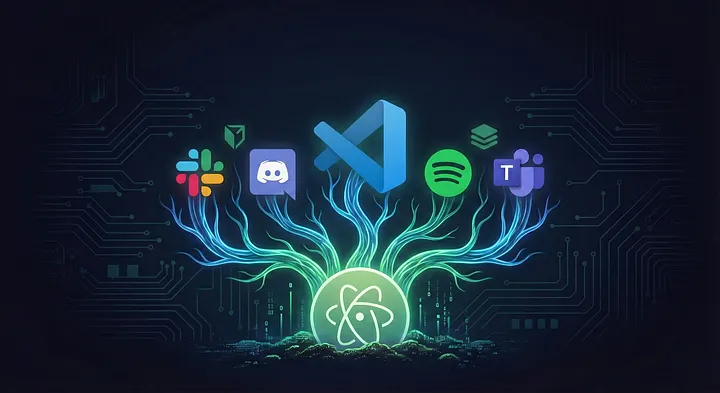
Three years ago today, Atom was archived. Yet its ideas still define how we write code.
On December 15, 2022, GitHub archived Atom and all repositories under it. Today, December 15, 2025 — marks 3 years since Atom officially came to an end.
Atom wasn’t just a code editor. It was a revolution for the industry.
Chris Wanstrath, co-founder of GitHub, aimed to build a modern, hackable code editor using web technologies like HTML and JavaScript. Something like Emacs but without requiring developers to learn a niche editor-specific language. This is how Atom was born.
To run web apps as desktop apps, Chris & team developed Atom Shell, which combined Chromium’s rendering engine with Node.js. This allowed JavaScript to run on the desktop, transforming Atom into a full featured desktop application (Atom Shell was later separated and renamed Electron in 2015).
Atom had a successful public beta in 2014, attracting many new programmers due to its modern aesthetic and convenience. However, it faced backlash for initially being closed-source. He later made it open-source, which was well-received.
Electron had significant advantages for cross-platform development: uses JavaScript, faster iterations, and faster development! However, Electron powered apps, including Atom, became notorious for performance issues & huge memory consumption, because well — they are basically embedding a browser in each app!
Microsoft, known for making Visual Studio, developed Monaco (its browser-based editor) and then later Visual Studio Code using Atom Shell (Electron). VSCode quickly gained popularity because it was 4x faster than Atom, due to optimized extensions that ran in isolated processes and efficient data encoding.
In 2018, Microsoft acquired GitHub.
Despite initial promises to support Atom, VSCode continued to receive updates and Atom was reaching end of life. On December 15, 2022, GitHub archived Atom.
While Atom the editor died, its “idea” won.
Electron, the Atom Shell, powers a huge part of the modern desktop apps today — Slack, Discord, Spotify, Teams — you name it.
This is what happens to Open Source products — their legacy is carried on as new forks arrive. Three years later, Atom’s legacy is still compiling.
Rich extensions, fast search, theming systems, language servers, and tight Git integration didn’t become standards by accident. Atom helped normalize them.
Respect to the engineers, contributors, and community that changed how developers write code.
#Atom #TechLegacy #OpenSource #DeveloperExperience #Programming #GitHub #SoftwareEngineering
This article is also published on Medium.